Why Ci Flow

Improvement work fails on connection, not on effort

Ci Flow was not designed in a product workshop. It came out of twenty years of running improvement programmes and watching good analysis lose to broken handover.

How the idea was born

Four steps, over two decades, from a recurring frustration to a rule that decided the architecture.

  1. 01

    Twenty years of watching the same failure

    Jvalin Sonawala has run transformation and operational excellence work across banking, utilities, telecommunications, healthcare and government. Different industries, different regulators, different words for the same thing. The pattern never changed.

    The analysis was almost always good. Belts knew their tools. They could run a capability study, build a fishbone, read a control chart. What failed was everything around the analysis. The baseline moved between the Measure gate and the closing report. The evidence behind a decision lived in one person's laptop. The tollgate deck was rebuilt by hand the night before, from memory, because nothing connected the worked tool to the slide.

    Executives do not remember how rigorous the hypothesis test was. They remember that the number changed twice and nobody could say why.

  2. 02

    Teaching made the gap impossible to ignore

    Running Lean 6 Sigma Hub put the problem under a microscope. Hundreds of Yellow, Green and Black Belt candidates came through the training, learned the method properly, and went back to work.

    Then the emails started. Not about statistics. About logistics. Which template do I use for the Measure gate? How do I show my sponsor the link between the Pareto and the charter? My Cpk moved and I do not know which version of the data produced the first number.

    The method was never the bottleneck. The method was fine. What people lacked was somewhere for the method to live.

  3. 03

    The doctorate sharpened the diagnosis

    Doctoral research produced the Navigate Framework, an eight-phase approach to enterprise transformation. The research forced a harder question than any single project ever had. Why do improvement programmes decay at a predictable rate regardless of the quality of the individual projects?

    The answer was structural. Classic DMAIC assumes somebody already chose the right problem, and it hands the gain over at Control with no mechanism to keep it. Selection happens before the method starts. Sustainment happens after the method ends. Both sit outside the thing everyone is trained on.

    That is why Ci Flow runs RDMAICS. Recognize puts problem selection inside the method, with its own tools and its own gate. Sustain puts handover, audit and replication inside the method too. The two phases nobody is graded on become the two phases the software insists on.

  4. 04

    One rule decided the architecture

    By the time the build started, AI could write a fluent paragraph about a control chart. That was exactly the danger. A model that writes confidently about statistics it did not compute is worse than no model at all, because it is wrong in a voice that sounds right.

    So Ci Flow was built on a rule that has never been relaxed. The AI never calculates. Every statistic comes from a deterministic engine, validated against NumPy and SciPy. The model receives the finished calculation as a source of truth it is not permitted to alter, and its only job is to explain the result in operational language.

    Run the same worksheet three times and you get identical numbers to nine decimal places. The explanation is written fresh each time. The figures never move.

The method was never the bottleneck. People had nowhere for the method to live.

Dr Jvalin Sonawala, founder

How most programmes run today

  • Templates scattered across spreadsheets, slides and shared drives
  • Baselines that change between the Measure gate and the final report
  • Decks rebuilt by hand the night before every tollgate
  • Statistics computed in one tool and interpreted from memory in another
  • Gains that quietly decay a few months after handover
How they run with Ci Flow

  • One workspace per project, with evidence carried between phases
  • Deterministic statistics with AI interpretation on top of the real numbers
  • Tollgate decks generated from worked, saved tools only
  • Four methodologies so the method fits the size of the problem
  • Sustain phase, audits and replication built into project closure

Proof, from the real product

Screens from the working platform, not concept art.

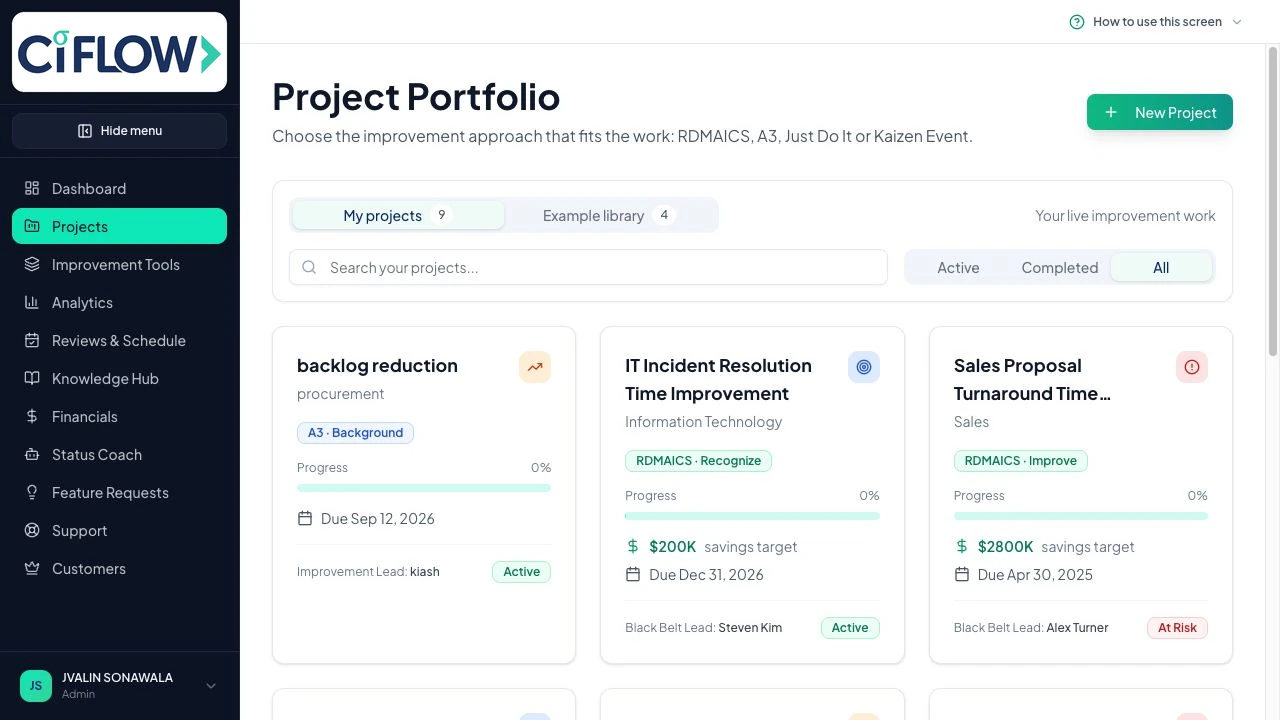
Ci Flow project portfolio listing improvement projects, methods, progress and value

One searchable improvement portfolio

Method, owner, phase, deadline and value stay visible across every live initiative.

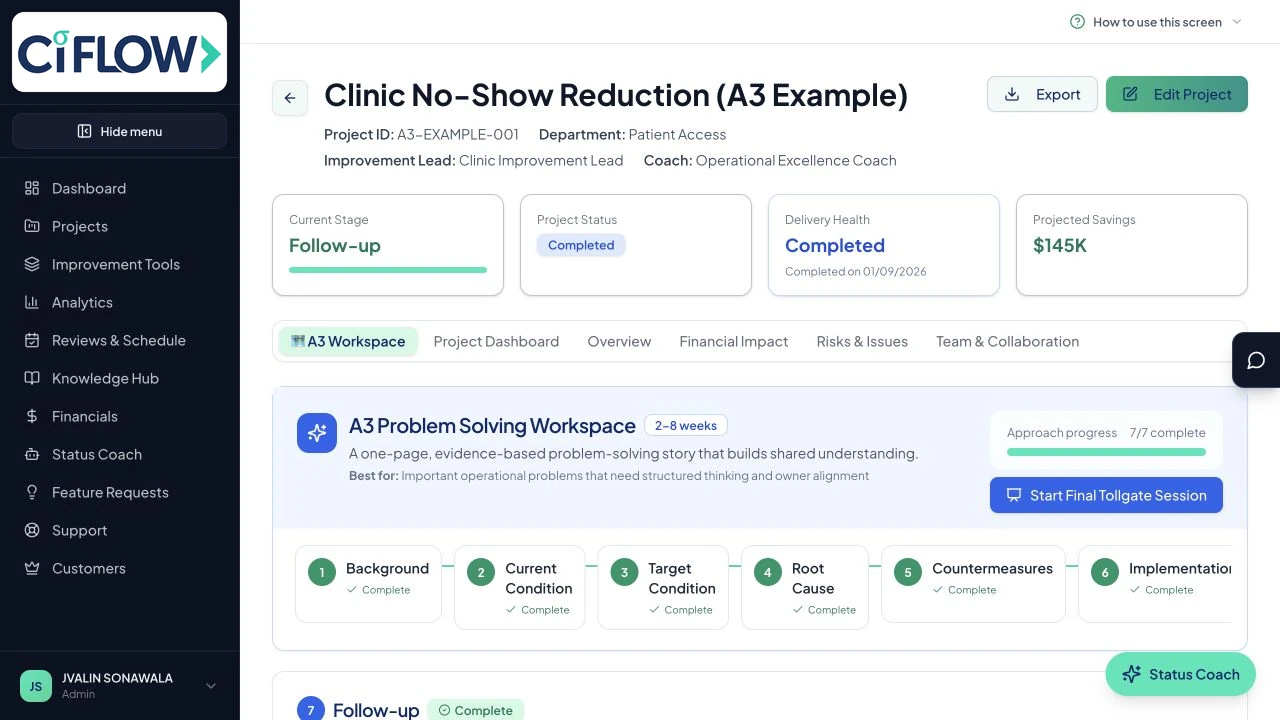
Ci Flow A3 problem-solving workspace showing the seven project stages

Right-sized project journeys

RDMAICS for rigour, A3 for learning, Just Do It for speed, Kaizen for focused events.

Completed Ci Flow BPMN 2.0 process map with swimlanes and gateways

Real process models, not drawings

Validated BPMN 2.0 maps, value stream maps and spaghetti diagrams with timing analysis.

Ci Flow tollgate presentation with Pareto evidence and stakeholder explanation

Reviews built from evidence

Every evidence slide carries the explanation your stakeholders need to decide.

See it on your own project

Start free for 14 days with example RDMAICS, A3, Just Do It and Kaizen projects included.

Meet the team behind it
Ci Flow

Ci Flow connects improvement methodologies, guided tools, project evidence, AI support, collaboration and tollgate presentations in one operational-excellence workspace.

RDMAICS · A3 · Just Do It · Kaizen

© 2026 Ci Flow. All rights reserved.

Built for evidence-led continuous improvement