All articles

Methodology

TRIZ without the jargon: one contradiction, start to finish

TRIZ is the most abandoned tool in the Improve phase, and the reason is always the same. This is one contradiction worked end to end in a pizza kitchen, with every screen shown, including what the method will not do for you.

Dr. Jvalin Sonawala 23 September 2026 8 min read
The TRIZ tool in Ci Flow showing the four steps and the limits panel

Why TRIZ gets abandoned

Ask a room of Green Belts which Improve tool they have used least. TRIZ wins every time. Not because the method is weak. Genrich Altshuller built it from 400,000 patents, and the contradiction matrix he published resolves conflicts that brainstorming circles around for hours. It gets abandoned because of one step in the middle.

To use the matrix you have to express your problem as two of 39 engineering parameters. Those parameters are named for mechanical patents. Weight of moving object. Volume of stationary object. Stress or pressure. You are working on an invoice queue or a claims backlog, and the tool hands you a list of 39 things that sound like they belong in a machine shop. So you close it and run a brainstorm instead.

Most TRIZ software makes this worse by giving you a blank table with five text columns. Type anything you like into Improving Parameter and it accepts it. Type Banana and it accepts that too, then reports that you have generated four ideas. It never opened a matrix. Nothing was looked up. You have a spreadsheet with a TRIZ label on it.

What a technical contradiction actually is

A technical contradiction is one sentence with two halves. Improving one thing makes another thing worse. That is the whole definition. If your sentence has only one half, it is a wish, and the matrix cannot use it.

Take a pizza kitchen. Friday night, tickets stacking up, and the obvious move is to speed up preparation. Do that and the pizzas stop coming out the same. Too much cheese on one, a missing topping on another. That is a contradiction. Speed against consistency.

Notice what it is not. It is not "we need to be faster". It is not "quality is a problem". It is the specific tension between the two, which is the thing the matrix knows how to resolve.

  • Improving one thing makes another thing worse. Both halves, or it is not a contradiction
  • State it in your own words first. The translation into TRIZ parameters comes second
  • If the same parameter has to take two opposite values at once, that is a physical contradiction and the matrix has no entry for it

Step 1. Write the conflict in your own words

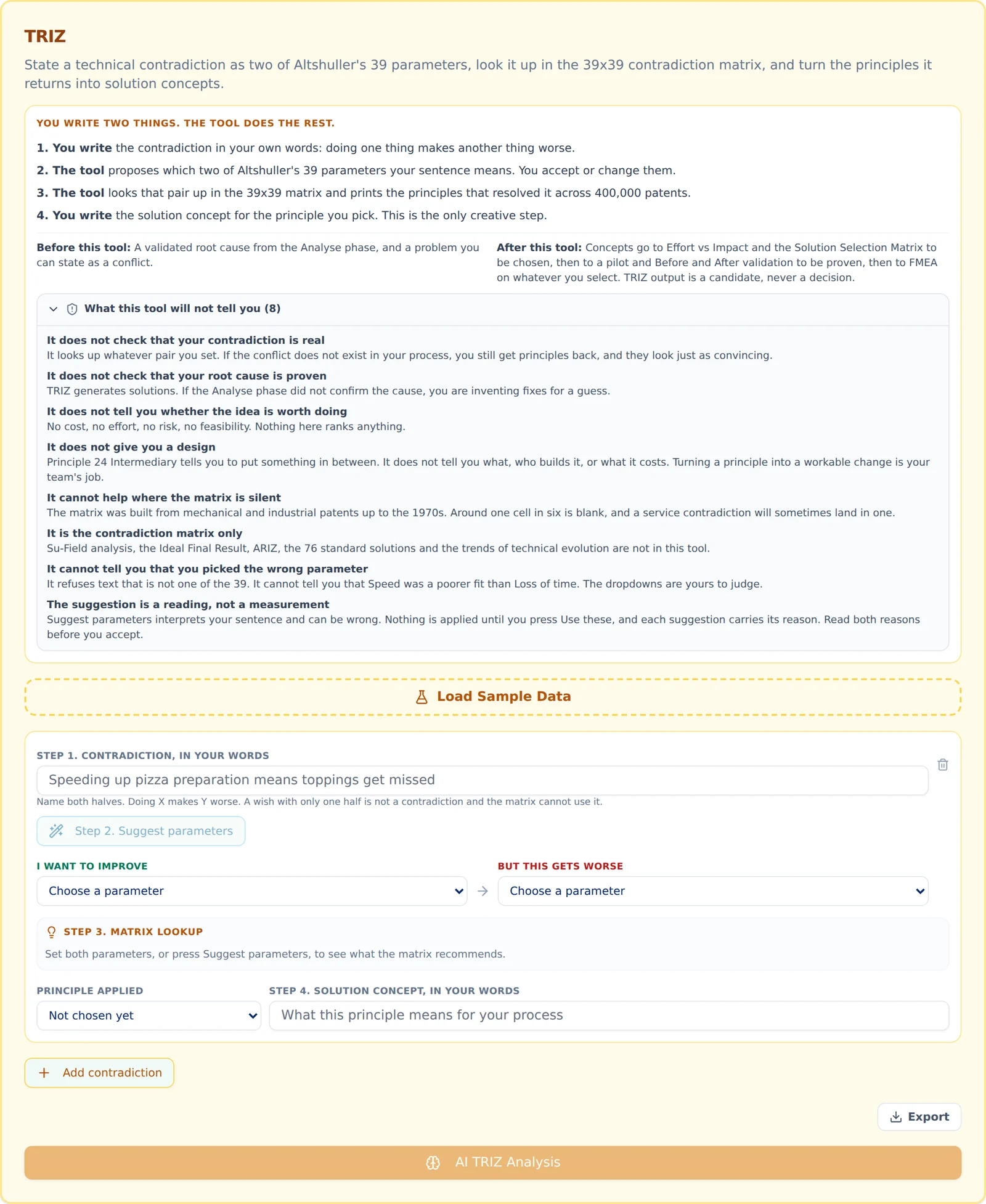
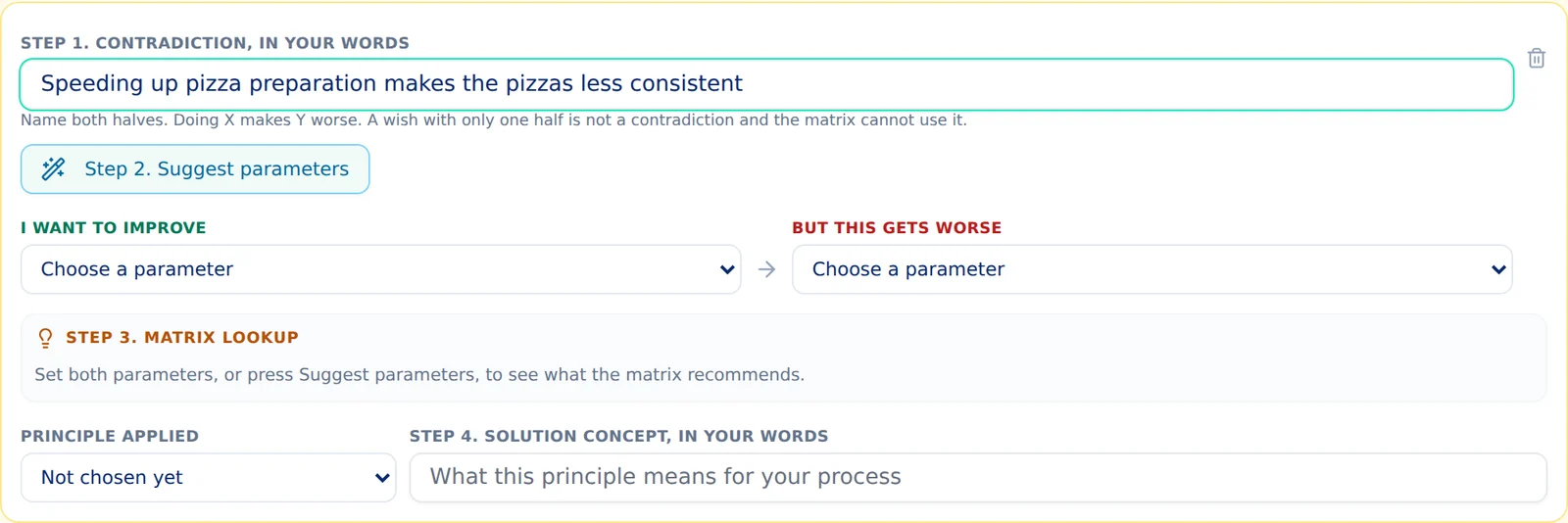
In Ci Flow the first box asks for the contradiction in plain language. No parameter numbers, no TRIZ vocabulary. You write what is happening in your process.

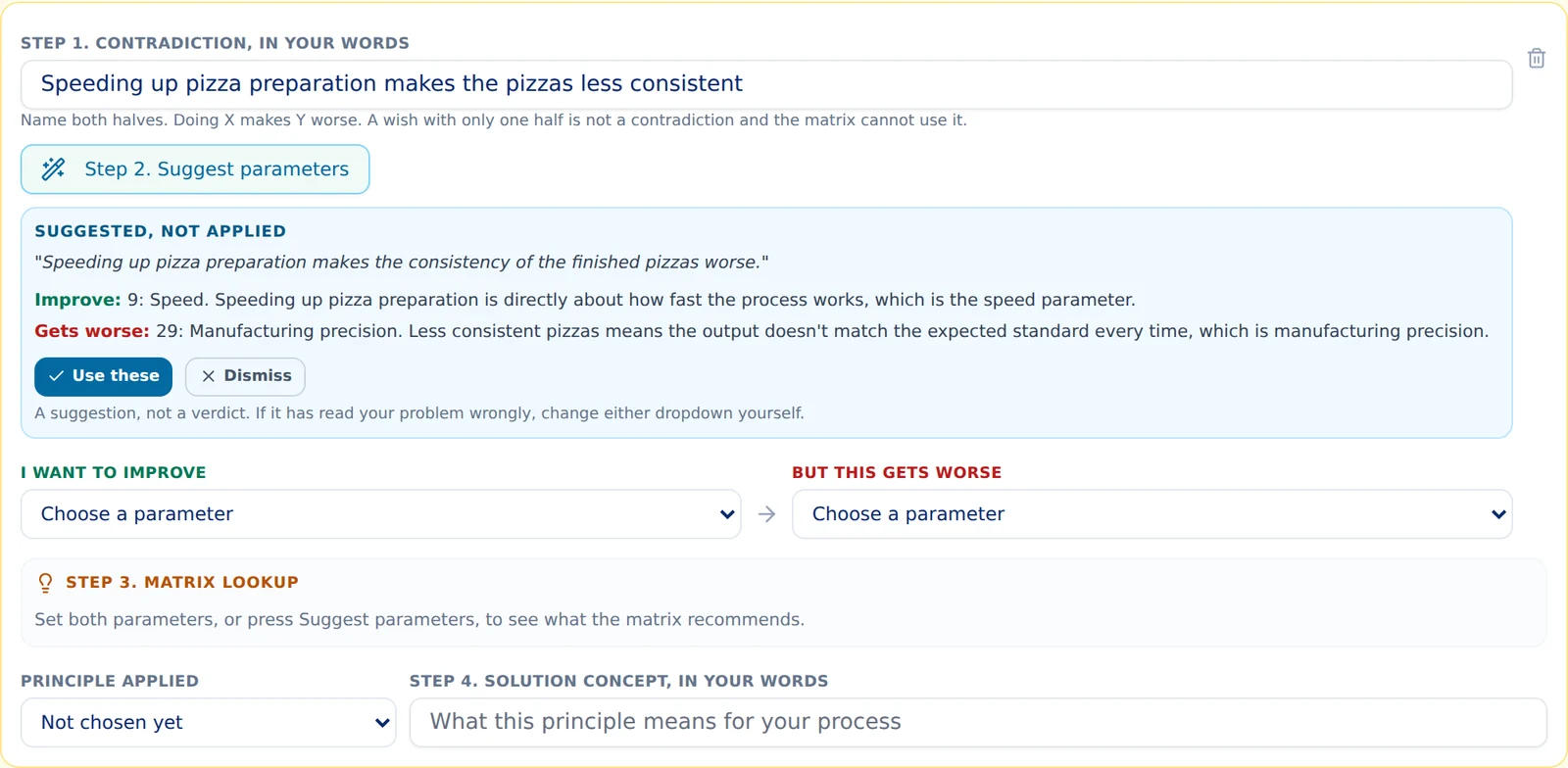
For the kitchen: speeding up pizza preparation makes the pizzas less consistent. That is it. Two halves, one sentence, written the way you would say it to the head chef.

Ci Flow TRIZ tool with the pizza contradiction typed into step one
Step 1. The contradiction written in plain language, before any TRIZ vocabulary is involved.

Step 2. Let the tool find the two parameters

This is the step that kills TRIZ elsewhere, and it is the step you should not do by hand. Press Suggest parameters and the tool reads your sentence and proposes the pair, with a reason for each in the same everyday language you used.

For the pizza sentence it proposed Speed as the parameter to improve, because speeding up preparation is directly about how fast the process works. For the parameter that gets worse it proposed Manufacturing precision, because less consistent pizzas means the output does not match the expected standard every time.

Nothing is applied. The proposal sits there with a Use these button and a Dismiss button. Read both reasons before you accept. If the tool has read your problem wrongly, change either dropdown yourself. A suggestion is a starting point, not a verdict, and a wrong parameter produces a confidently wrong set of principles that you cannot tell apart from a right one.

Ci Flow proposing Speed and Manufacturing precision with a reason for each
Step 2. The tool proposes Speed against Manufacturing precision and gives its reason for each. Nothing is applied until you press Use these.

Step 3. Read what the matrix returns

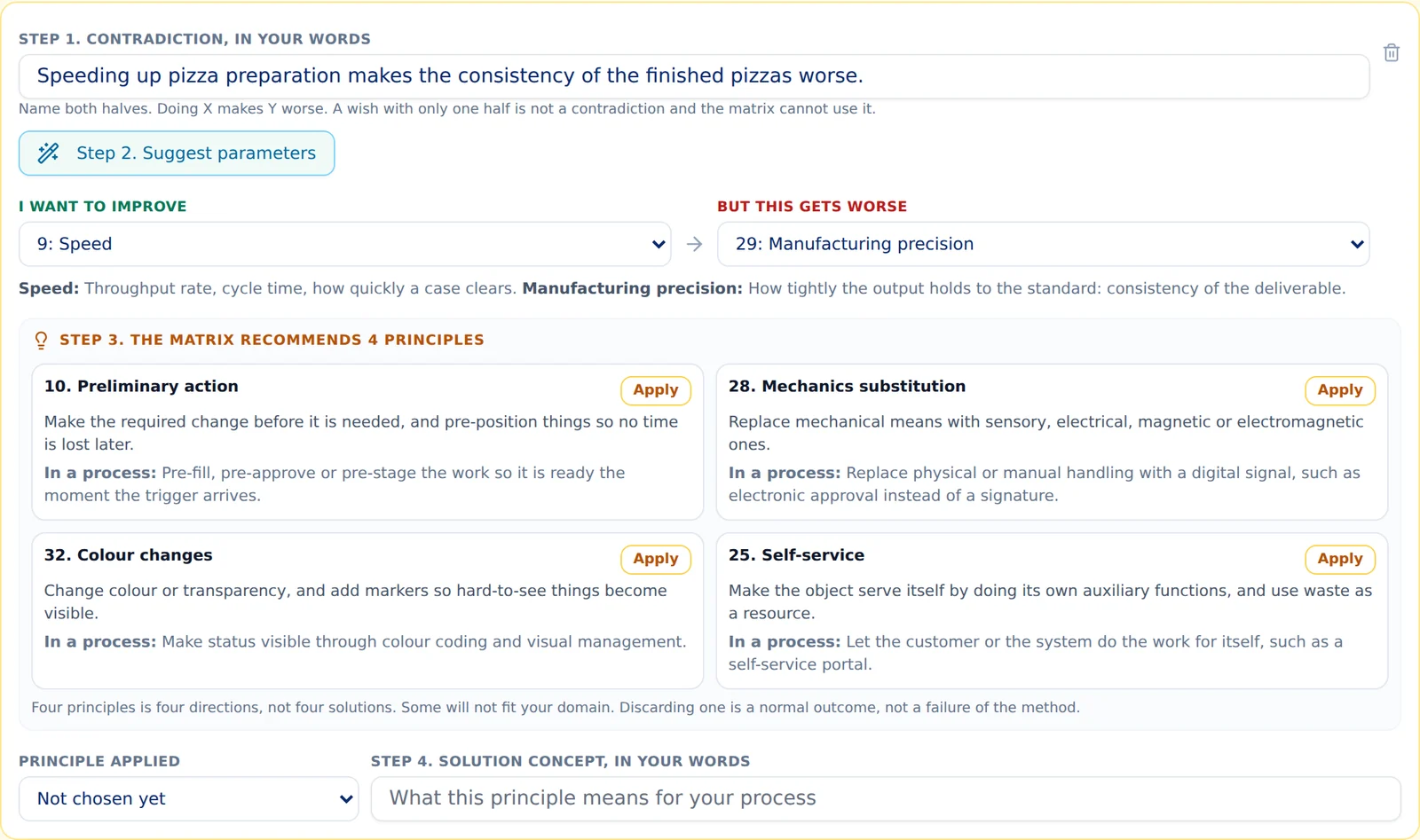
Speed against Manufacturing precision resolves to four principles in Altshuller's matrix: 10 Preliminary action, 28 Mechanics substitution, 32 Colour changes and 25 Self-service. They arrive in the published order, strongest first.

The names are physical because Altshuller derived them from patents, and nobody gets to rename them. What the tool adds is a second line on every card saying what the principle looks like in a process rather than in a machine. Your job is to read both lines and ask what this would mean in your kitchen.

Principle 10, Preliminary action, says do the required change before it is needed. In a kitchen that is par-baking bases and portioning toppings before the rush. Principle 28, Mechanics substitution, says replace manual handling with a signal. That is a conveyor oven with a timer instead of a chef judging the bake by eye. Principle 32, Colour changes, says make hard-to-see things visible. That is colour-coded topping trays so a missing item is obvious at a glance. Principle 25, Self-service, says let the system do its own auxiliary work. That is a dough press that portions itself.

Four directions in under a minute, none of which came from the team staring at a whiteboard.

Four TRIZ principles returned by the contradiction matrix with process readings
Step 3. The matrix returns principles 10, 28, 32 and 25, in Altshuller's published order, each with what it means in a process.

Step 4. Write the concept

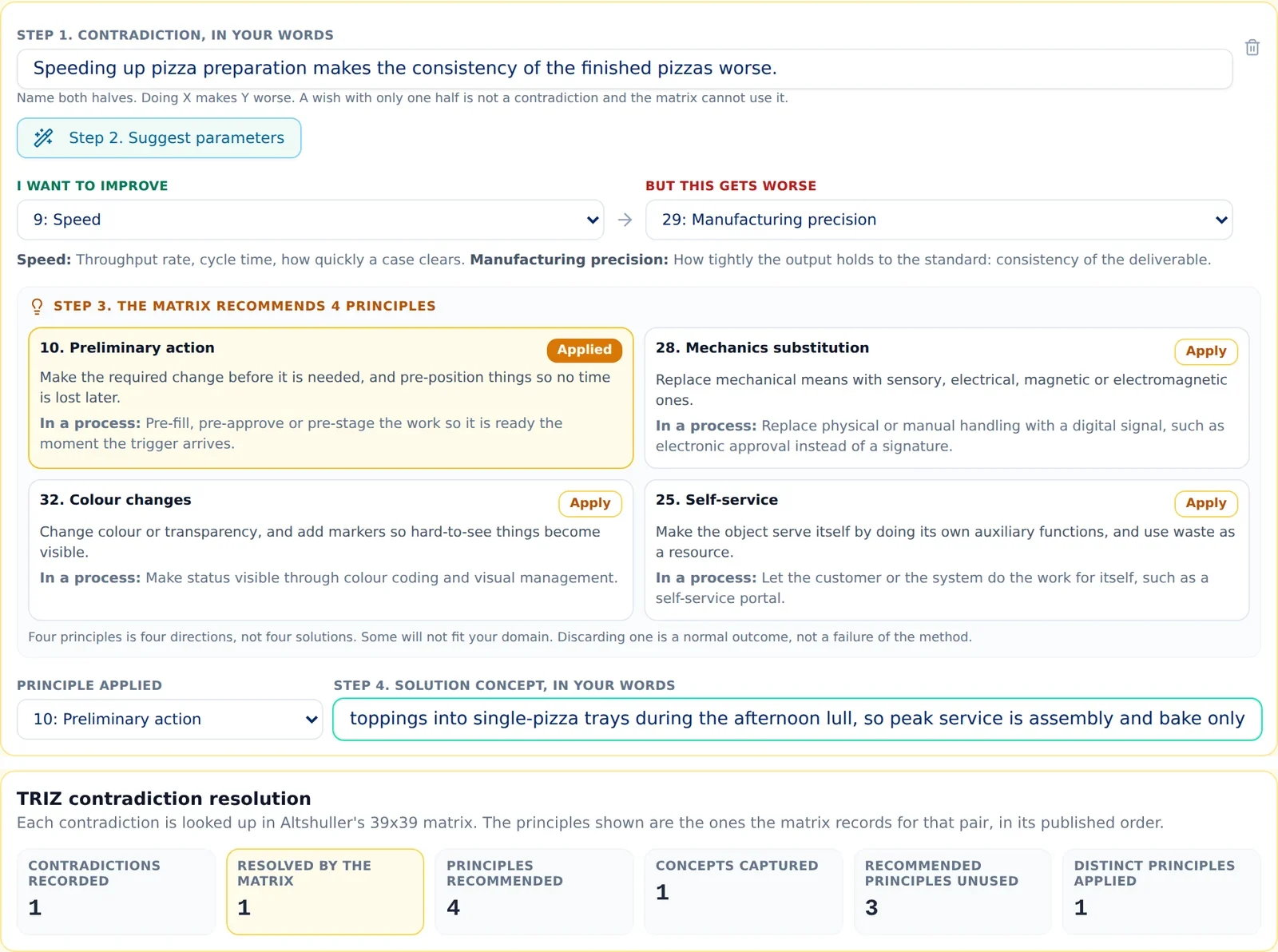
Press Apply on the principle you want and write what it means for your process. This is the only creative step in the method. TRIZ gives you the direction. It does not give you the design.

For the kitchen, principle 10 became: pre-portion toppings into single-pizza trays during the afternoon lull, so peak service is assembly and bake only.

The panel underneath then reports what the worksheet actually contains. One contradiction recorded, one resolved by the matrix, four principles recommended, one concept captured, and three recommended principles unused. That last figure is the useful one in a workshop. The matrix handed your team four directions and you have taken one. The other three are still on the table.

The tool is also strict about loose ends. Apply a principle and leave the concept blank and it tells you that nothing has been carried forward. That check exists because a principle with no concept behind it looks like progress in a tollgate pack and is not.

Completed TRIZ row with the solution concept and the verified output panel
Step 4. The concept written against principle 10, and the panel reporting that three recommended principles are still unused.

A second contradiction, ninety seconds later

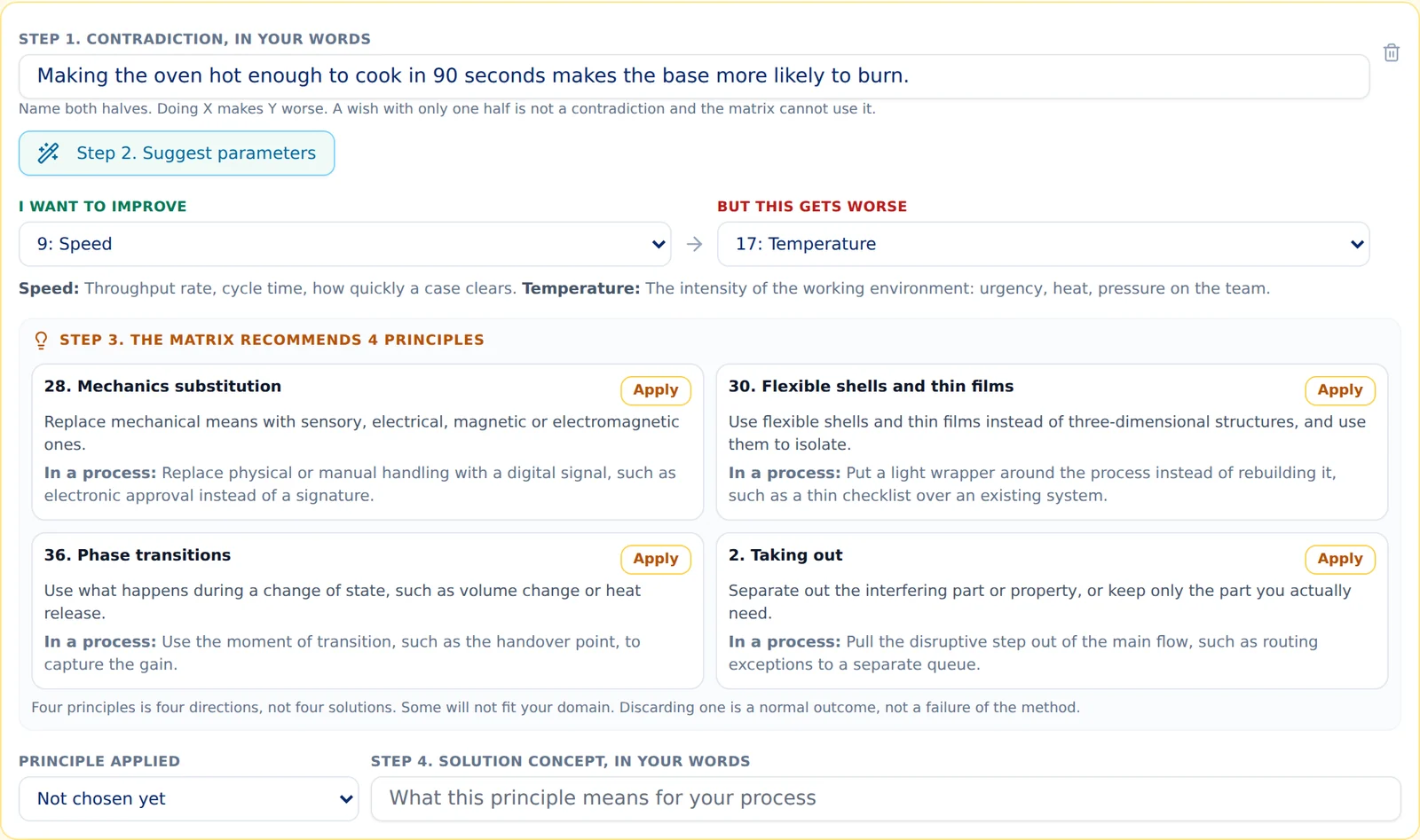
The same kitchen has another one. The oven must be hot enough to cook in 90 seconds and cool enough not to burn the base. Written plainly and passed through the same four steps, it resolves to Speed against Temperature, and the matrix returns 28 Mechanics substitution, 30 Flexible shells and thin films, 36 Phase transitions and 2 Taking out.

Principle 2, Taking out, is the interesting one. Separate the interfering part from the object. In a kitchen that means separating the base bake from the topping bake, so each gets the heat it needs. A stone-deck pre-bake for the base and a shorter finishing pass with toppings on. That idea took no brainstorm and no facilitator.

A second TRIZ contradiction resolving to principles 28, 30, 36 and 2
A second contradiction. Speed against Temperature returns a different four, including principle 2, Taking out.

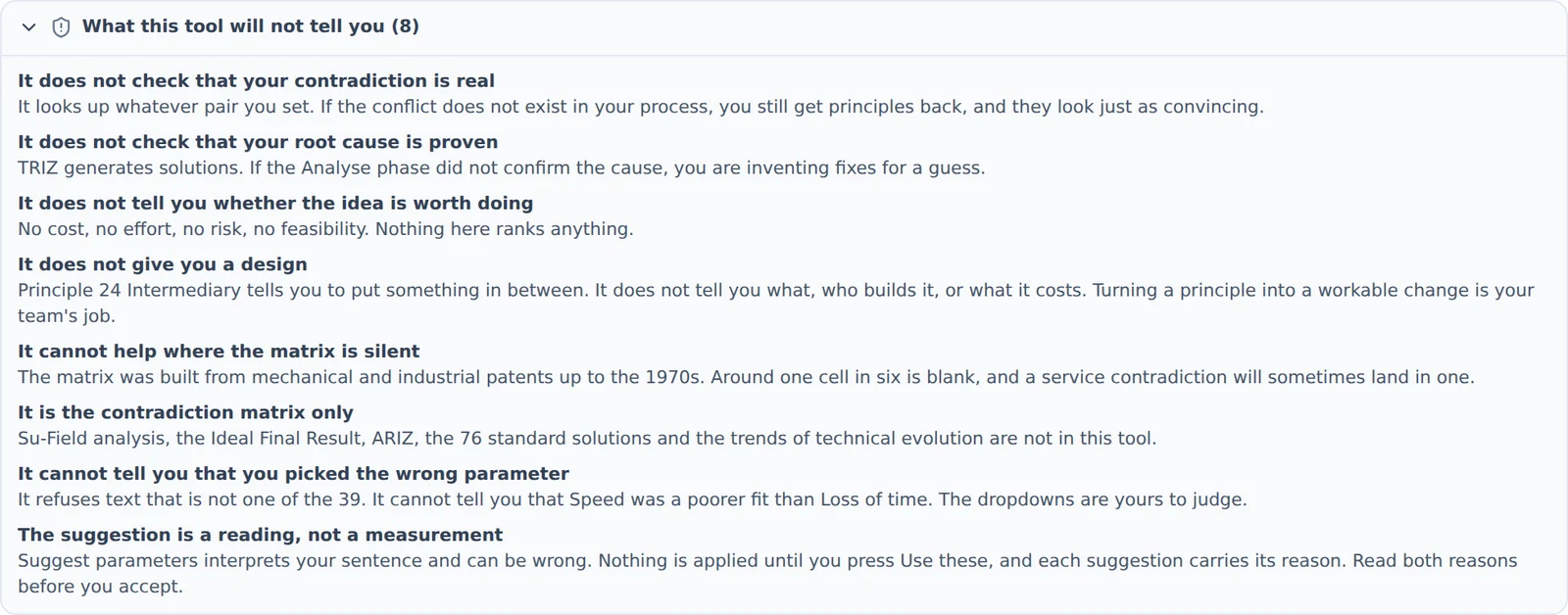
What TRIZ will not tell you

This is the section most TRIZ training leaves out, and it is the reason TRIZ output sometimes reaches a steering committee dressed as a decision.

The matrix does not check that your contradiction is real. It looks up whatever pair you set. If the conflict does not exist in your process, you still get principles back and they look just as convincing. It does not check that your root cause is proven either. TRIZ is a solution generator. Point it at an unvalidated cause and it will generate solutions for a guess.

It does not tell you whether the idea is worth doing. There is no cost in it, no effort, no risk, no feasibility. Nothing here ranks anything. And it does not give you a design. Principle 24, Intermediary, tells you to put something in between. It does not tell you what, who builds it, or what it costs.

It also has gaps. Around one cell in six is blank in Altshuller's original, and a service contradiction will sometimes land in one. The matrix cannot resolve a physical contradiction at all, where the same parameter has to take two opposite values, and for those you work from the separation principles instead: separation in time, in space, on condition, and between the parts and the whole.

Finally, the contradiction matrix is one part of TRIZ. Su-Field analysis, the Ideal Final Result, ARIZ, the 76 standard solutions and the trends of technical evolution are a much larger body of method. Anyone presenting a matrix lookup as a full TRIZ study is overstating it.
  • TRIZ output is a candidate, never a decision
  • Four principles is four directions, not four solutions. Discarding one is a normal outcome
  • A concept generated here has not been costed, risk assessed or piloted
The TRIZ limits panel listing eight things the tool will not tell you
The limits sit beside the tool, not in a footnote, and they travel into the export.

Where this sits in RDMAICS

Before you open TRIZ you need a validated root cause from the Analyse phase and a problem you can state as a conflict. Without the first, you are inventing fixes for a guess. Without the second, the matrix has nothing to look up.

After TRIZ, the concepts go to the Effort vs Impact matrix and the Solution Selection matrix to be chosen, then to a pilot and a before and after comparison to be proven, then to FMEA on whatever you select. The path from a principle to an implemented change runs through all of it.

Used that way, TRIZ earns its place in Improve. It is the fastest way to get a team unstuck when the obvious solutions all trade one thing away for another, and it takes about eight minutes per contradiction once you stop trying to translate 39 parameters in your head.

TRIZ contradiction matrix40 inventive principles39 engineering parameterstechnical contradictionLean Six Sigma Improve phaseTRIZ worked example

Run this method inside Ci Flow

RDMAICS, A3, Just Do It and Kaizen projects with the full Lean Six Sigma toolset, AI interpretation and tollgate presentations built from your real evidence.

Keep reading

Ci Flow

Ci Flow connects improvement methodologies, guided tools, project evidence, AI support, collaboration and tollgate presentations in one operational-excellence workspace.

RDMAICS · A3 · Just Do It · Kaizen

© 2026 Ci Flow. All rights reserved.

Built for evidence-led continuous improvement